
Inversion of Control: The Most Important Mindset in the AI Era
Inversion of Control: The Most Important Mindset in the AI Era
The idea of "Inversion of Control" has changed the way I think.
With the capabilities AI has today, in more than 99% of the situations I deal with, I now reach for the IoC mindset before anything else. What do I control? What do I invert? What concrete work do I hand to AI, and what abstract judgment do I keep for myself? What should be generalized, and what must be defined precisely and executed by the machine? Once you can answer these questions reliably, you have already drawn the boundary between what you do and what AI does for you.
I have come to believe that the rarest skill in the AI era is hidden inside this single concept.
1. What Inversion of Control Actually Means
Inversion of Control (IoC) was originally a software engineering idea.
In traditional code, the main program is responsible for triggering every call. It decides which component to use, what arguments to pass, which branch to take. Every concrete action is initiated explicitly by the top-level code, and control sits firmly in its hands.
IoC flips this around. The main program no longer schedules every detail. It steps back and defines interfaces, contracts, and constraints, then hands the responsibility of "how to actually do it" over to a framework or a container. The framework, at the right moment and according to the agreed protocol, calls the right component on its behalf.
It sounds technical, but the spirit is simple:
- The upper layer defines what is valid, what the goal is, and where the boundaries are.
- The lower layer is free to do whatever it takes inside those boundaries.
- The upper layer does not need to know how the lower layer is implemented, and the lower layer does not need to know who is calling it.
A UML class diagram makes the shift visible. Same two actors — Human and AI — yet the direction of the dependency arrow changes everything.
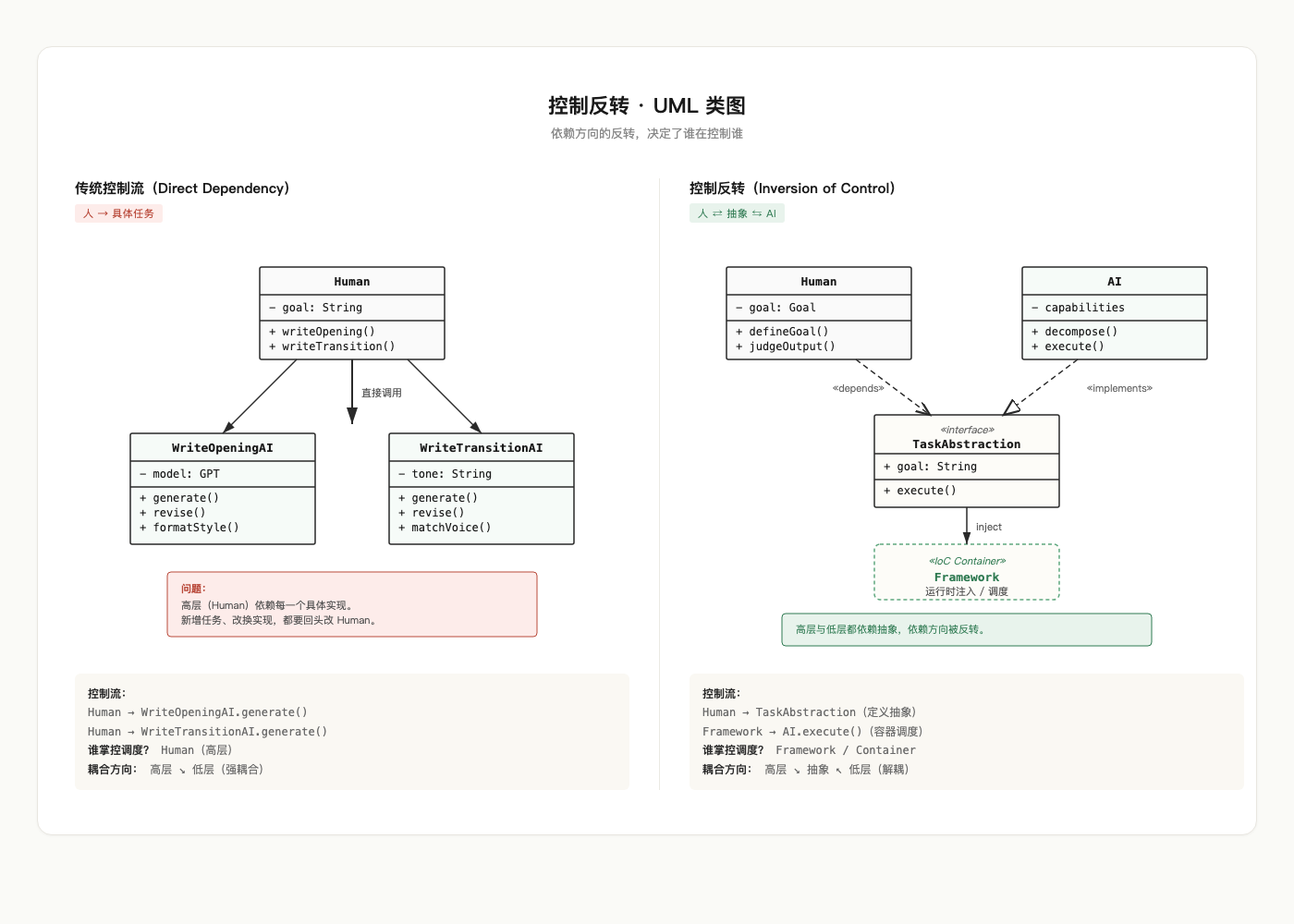
On the left is the traditional control flow. The Human class holds direct references to concrete implementations like WriteOpeningAI and WriteTransitionAI, and the arrows point from the high level down to the low level. Every new task means another outgoing arrow from Human; every change in implementation forces Human to change as well. The high level is dragged around by the low level.
On the right is Inversion of Control. Human no longer depends on any concrete AI implementation. It depends on an abstract interface, TaskAbstraction, which only declares "what the goal is and what needs to be executed", and stays silent about how. AI implements that interface and provides the actual execution capability. In the middle, an IoC Container (the framework) wires the two together at runtime: it injects an AI into wherever Human needs one, and it schedules the execution.
The arrows have been reversed. Both the high level and the low level point inward toward the abstraction; neither directly depends on the other. That is exactly where the name "Inversion of Control" comes from — control has moved out of the high-level code and into the container, and the direction of dependency has been flipped.
When you map this back onto human–AI collaboration, the TaskAbstraction is the goals and boundaries you hold clearly in your head. The Framework is the workflow and constraints you have set up. And AI is what runs freely inside that frame.
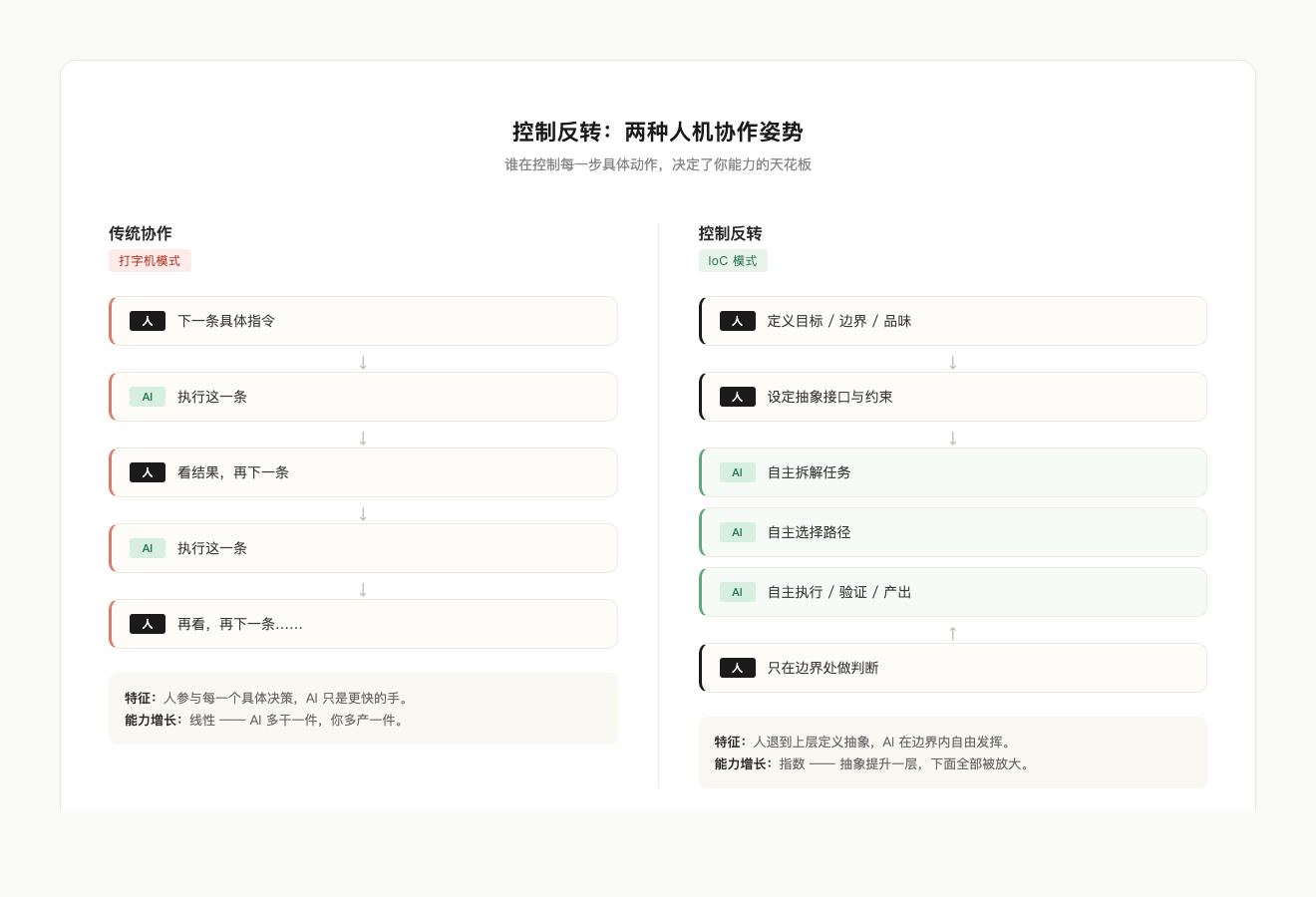
The left side is how most people work with AI today: the human stays in every concrete decision, and AI is just a faster pair of hands. The right side is the IoC posture: the human pulls back to a higher layer to define abstractions, and execution is delegated wholesale. The two postures look only a step apart, but they send your capability curve in completely different directions.
2. Two Postures of Human–AI Collaboration
If you watch the people around you using AI, you start to notice two very different postures.
The first treats AI as a faster typewriter.
The user issues every instruction by hand: "write me an opening", "tweak this line", "change the tone", "add a transition". AI responds quickly in front of them, but every judgment, every rhythm, every decision about direction still sits on the user's shoulders. The longer they work, the more tired they get, because the cognitive load has not gone down — only the typing has been outsourced.
The second posture is Inversion of Control.
Here, the user stops initiating each concrete action. They retreat to a higher layer and define the abstractions: what problem am I solving, what is the goal, where are the boundaries, what counts as a good output, what counts as a failure. Then they hand the entire question of "how" over to AI. AI breaks down the task, picks a path, writes the code, runs it, validates the result, and produces an output. The human only judges at the abstract layer: is the direction right, do the boundaries need to be tightened, does the result match the bar I set in my head.
These two postures determine how fast a person climbs the capability curve in the AI era.
People in the first posture grow linearly. AI helps them do three more things today, so they get three more things done.
People in the second posture grow exponentially. What they are training is the ability to define abstractions, and once that ability moves up a level, every concrete execution underneath gets multiplied. Today they can define a project-level abstraction; tomorrow, a business-level one; the day after, an organizational one. Each step up multiplies the volume of work AI runs on their behalf by another order of magnitude.
3. The Boundary Between You and AI Is Set by the Level of Abstraction
What IoC thinking really tells you is something deeper. The boundary between what you do and what AI does is, fundamentally, set by the level of abstraction at which you can hold your judgment steady.
Whatever layer you can reliably evaluate is the layer at which AI takes over everything below.
If you can only judge "is this sentence well-written", AI can only write sentences for you, and you have to review them one by one.
If you can judge "is this paragraph logically sound and well-paced", AI can write paragraphs, and you only review at paragraph level.
If you can judge "does this entire piece carry its theme, does it convey what I intended", AI can write whole essays, and you only review at the essay level.
If you can judge "does this topic belong on my content line at all, in what format, for which audience", AI can run the entire content production pipeline, and you only step in at topic selection.
Every step up the abstraction ladder multiplies the scope you control and divides the work you must do by hand. This is why the same tool produces wildly different results: some people see their output snowball, while others remain stuck inside the typewriter loop. The difference has nothing to do with the tool. It is about the layer at which you can stand steady.
4. Three Pillars That Hold the IoC Posture Up
To put this mindset to work, three pillars must hold.
The first pillar: be sharply aware of what you are controlling.
Inversion of Control is not the same as letting go. It demands the opposite — a clear consciousness of what exactly you are controlling. You are controlling the definition of the goal, the placement of the boundary, the judgment of taste, the choice of direction. These cannot be delegated and should not be. The moment you become vague at this layer, AI becomes vague along with you, and you end up with a pile of outputs that "look correct but are not what you wanted".
The second pillar: be sharply aware of what must be specified.
Not everything can be generalized. Some constraints will never be guessed correctly unless you spell them out. This article must use Chinese punctuation. It must avoid a particular sentence pattern. It must stay under a certain word count. It must speak to a specific reader. It must not step on certain landmines. These are concrete, definable, and must be handed to AI explicitly. Once they are written down, AI is free to perform inside the frame.
The third pillar: be sharply aware of what AI should run on its own.
How to open the piece. How to transition. How to phrase a sentence. How to organize an example. Which tools to invoke. How to debug the code. These are the things AI can do faster than you, and sometimes better. Hand them over and stop micromanaging. The instant you start to hover at this layer, IoC collapses, and you slide back into typewriter mode.
When all three pillars hold, you are practicing real IoC, instead of just using a fancier mouthpiece.
5. Closing
AI's capabilities continue to expand at a visible pace. Every few months, the ceiling of what counts as "concrete execution" rises another notch, and a new batch of tasks that used to need your hands gets absorbed into the layer where AI runs on its own.
Under that tempo, only one real question is left for the individual: can you keep climbing toward higher abstractions?
If you can, the stronger AI becomes, the stronger you become — because the surface area it executes on your behalf keeps growing.
If you cannot, the stronger AI becomes, the more anxious you feel — because the work you used to do is being eaten away one layer at a time.
The IoC mindset is the ladder that helps you climb. It does not teach you to write faster or type more accurately. It teaches you to stand at a higher altitude, to define what is worth doing, what counts as good enough, and what falls under your judgment alone, and then to hand over everything else to AI with confidence.
Whoever has clearly answered the question "what do I control, what do I invert" is already standing on the right side of the capability curve in the AI era.
If you read this far — thank you.
Come tell me what you thought on X.